Luzhe Sun

Luzhe Sun

Ph.D. Candidate @ TTIC - Robotics Planning and Diffusion Models

I'm a Ph.D. candidate at TTIC advised by Professor Matthew R. Walter in the Robot Intelligence through Perception Lab (RIPL). Before TTIC, I completed my master's in Computer Science at the University of Chicago and my undergraduate studies at Xiamen University.

Research interests: robotics planning, shared autonomy, diffusion/consistency models, and embodied AI. I also enjoy photography, Chinese painting, and playing the Erhu.

Open to collaborations - seeking a Summer 2027 internship

Email: luzhesun@ttic.edu | luzhesun@uchicago.edu

Ph.D. in Computer Science
Toyota Technological Institute at Chicago
2023 - Present
Master of Computer Science
University of Chicago
2021 - 2022
B.Eng in Information Science, Graduated With Honor
Xiamen University
2017 - 2021

Latest News

Sep 2026
Paper Accepted! Our paper "What Are We Actually Benchmarking in Robot Manipulation?" has been accepted to CoRL 2026.
May 2026
Gold Reviewer! I'm ranked as a Gold Reviewer for ICML 2026.
Mar 2026
Paper Accepted! Our paper "Seeing without Looking: Do Vision-Language Benchmarks Really Test Vision?" has been accepted to CVPR 2026 GRAIL-V Workshop.
Mar 2026
Code Released! We released the code for FlashBack on CoRL 2025.
Jan 2026
Paper Accepted! Our paper "Detecting Hallucinations in Vision-Language Models without Generating a Single Token" has been accepted to EACL 2026 Main (Oral).
Oct 2025
Invited Livestream! Our paper "FlashBack" was invited for livestream presentation at CVlife and 3dcver.

Publications

Selected Publications

Flow-based Policy Adaptation without Policy Updates

Luzhe Sun*, Jingtian Ji*, Haoran Chen, Jiawei Zhou, Matthew R. Walter

TL;DR: GLOVES uses flow matching to selectively pull out-of-distribution actions from humans or pretrained policies toward expert behavior—without updating the underlying policy. With limited demonstrations, it improves imperfect imitation-learning and VLA agents across simulated and real-robot tasks.
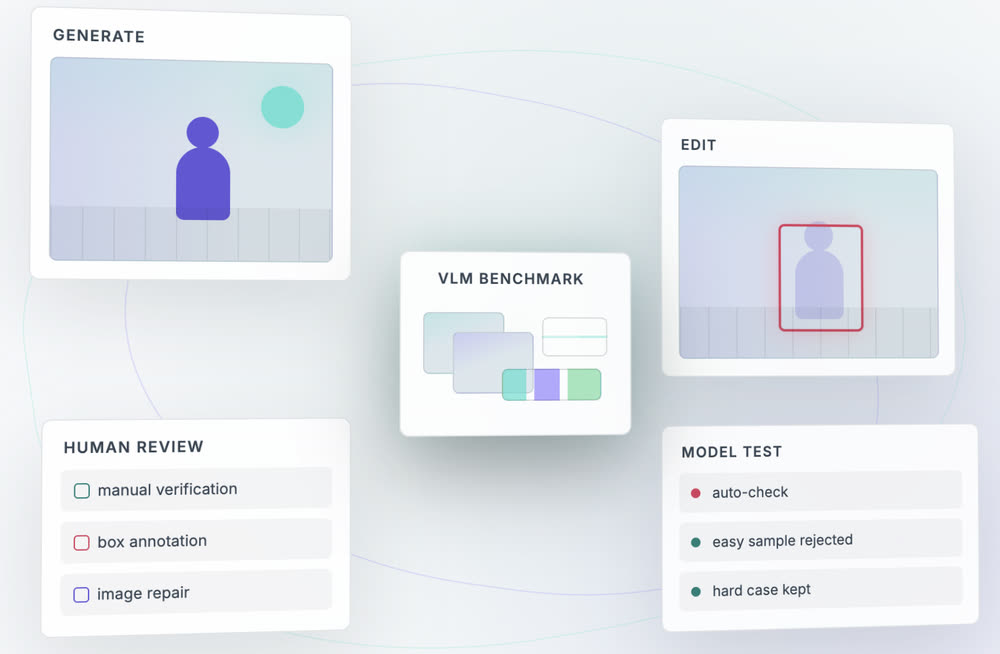
SABRE VLM benchmarking pipeline

SABRE: Scalable and Automated Benchmarking of VLMs under Stress

Zixuan Lan*, Luzhe Sun*, Matthew R. Walter, Jiawei Zhou

TL;DR: SABRE turns natural-language test specifications into automatically generated, filtered, and human-verified VLM stress tests that can evolve with the models. Its SABRE-Prior benchmark exposes heavy reliance on world priors: six frontier VLMs score only 17.8–31.3% macro accuracy.

Robot manipulation benchmark audit chart

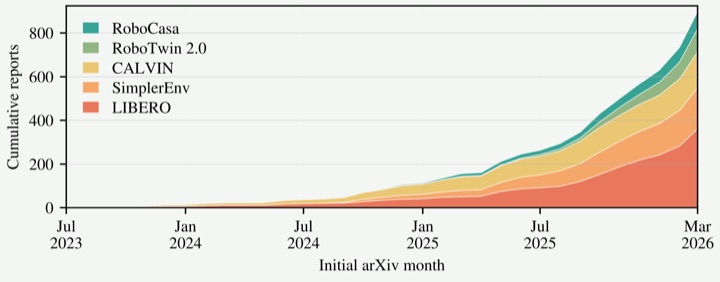
What Are We Actually Benchmarking in Robot Manipulation?

Tianchong Jiang, Xiangshan Tan*, Samuel Wheeler*, Luzhe Sun*, Tewodros W. Ayalew*, and Matthew Walter

TL;DR: Auditing five popular robot-manipulation benchmarks with four diagnostics reveals shortcuts, statistically unresolved gains, overfitting, and training-data proximity effects—especially on LIBERO, CALVIN, and SimplerEnv. The results show why benchmark scores alone often do not establish general manipulation progress.

CVPR 2026 workshop paper thumbnail

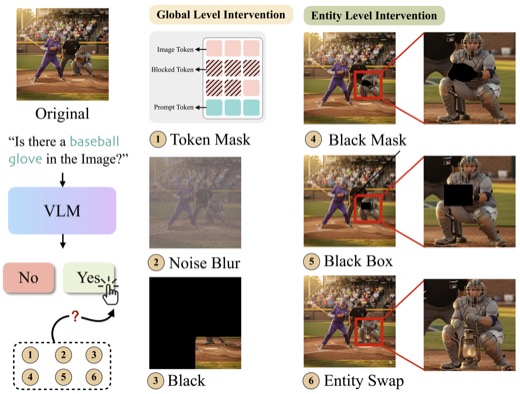
Seeing without Looking: Do Vision-Language Benchmarks Really Test Vision?

Zixuan Lan*, Luzhe Sun*, Matthew R. Walter, Jiawei Zhou

TL;DR: Across seven open VLMs, benchmark accuracy often remains surprisingly high after fine-grained visual evidence is masked, corrupted, or replaced: removing 75% of image tokens reduces POPE accuracy by only about three percentage points for some models. These results reveal a gap between benchmark performance and genuine visual grounding, motivating evaluations that measure whether predictions respond appropriately to changes in visual evidence.

To the Noise and Back: Diffusion for Shared Autonomy

Takuma Yoneda, Luzhe Sun, Ge Yang, Bradly Stadie, Matthew R. Walter

TL;DR: This work introduces partial diffusion for shared autonomy: noise and denoise a user's command toward demonstrated expert behavior, with a single knob trading off intent preservation and assistance. It needs no reward, dynamics, predefined goals, or user-policy data during training and improves both simulated and real-robot teleoperation.

More Publications

EACL 2026 hallucination paper thumbnail

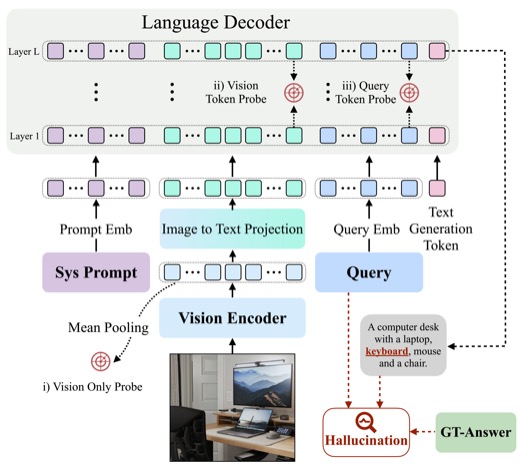
Detecting Hallucinations in Vision-Language Models without Generating a Single Token

Sai Akhil Kogilathota, Sripadha Vallabha E G, Luzhe Sun, Jiawei Zhou

TL;DR: HALP predicts whether a VLM will hallucinate before decoding by probing its visual and multimodal hidden states in one forward pass. Across eight VLMs, lightweight probes reach up to 0.93 AUROC while adding less than 1% overhead relative to full generation, enabling early abstention or selective routing.

Quantum GNN paper thumbnail

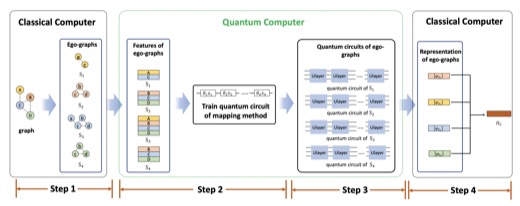
Decompositional Quantum Graph Neural Network

Xing Ai, Luzhe Sun, Zhihong Zhang, Junchi Yan, Edwin Hancock

TL;DR: egoQGNN decomposes arbitrarily large graphs into ego-graphs that fit a fixed-size quantum device and uses a trainable Euclidean-to-Hilbert mapping to limit information loss. In simulation, it achieves competitive classification accuracy on six molecular and protein datasets with just 43 parameters—1.68% as many as the smallest classical GNN baseline.

Service and Volunteer

Reviewer
Organizer
Invited Demo
2024 Robot Block Party at Griffin Museum of Science, Chicago, IL
Invited Demo
2023 Robot Block Party at Griffin Museum of Science, Chicago, IL
Volunteer
Midwest Robotics Workshop at TTIC, Chicago, IL

Awards and Honors

Gold Reviewer
2026 - International Conference on Machine Learning (ICML)
China National Scholarship (Top 0.1%)
2020 - Chinese Ministry of Education, China
China National Scholarship (Top 0.1%)
2019 - Chinese Ministry of Education, China
Honored Graduate Student
2021 - Xiamen University, China
National 2nd Prize of Contemporary Undergraduate Mathematical Contest in Modeling
2019 - China Society for Industrial and Applied Mathematics, China
National 3rd Prize of China Students Service Outsourcing Competition
2018 - Ministry of Education & Ministry of Commerce, China
Xiamen University "Xilie Huang" Annual Scholarship (2/200)
2018 - Xiamen University, China
Xiamen University Outstanding Student Worker Scholarship
2018 - Xiamen University, China

Mentoring

Xiaopeng Zhang, University of Chicago (Master) --> Rutgers University (Ph.D. student)